- The Universal Golf Rankings
- Posts
- TUGR Doesn't Throw Out Any Scores. Why?
TUGR Doesn't Throw Out Any Scores. Why?
"Not all +3 Handicaps are created equally"

TUGR Golf
June 04, 2025
A question we’re often asked is this: Does TUGR throw out any scores when calculating rankings?
In many ranking systems, including USGA Handicaps (GHIN), the bottom 20-25% of scores are not counted. While throwing out the worst scores of players may feel good to the individual, if the purpose of a ranking/skill system is to be accurate, then every shot must count.
A core pillar of TUGR Junior Rankings is to be the most accurate system in all of junior golf. That’s why we are transparent about everything we do.
The TUGR output of Relative Strokes is easy to understand and is based in pure math. Other systems don’t even publish their final output since it’s generally a weighted number, from many different inputs, and that weighted number in reality doesn’t mean anything, because it’s made-up.
Last year we did a large research project where we looked players ranked in the Top-1,000 of TUGR, and compared their TUGR Relative Strokes to their USGA Handicaps. While we published the results of this case study in January, we’ve had so many new users to TUGR that it’s worth rehashing.
The results are below from our January publication are below:
Case Study: USGA Handicaps & TUGR Relative Strokes
Quick Overview of Relative Strokes
One of the core pillars of TUGR Junior is to make sure everything we create and communicate is understandable. Transparency and understandability is of most importance. This filters right down to the numbers we post in the rankings, which is not a made-up number from a secret formula - it means something and can be helpful in your progression.
As most of you already know, “Relative Strokes” is the output of the TUGR Junior ranking system. The number next to any player in the rankings is their “Relative Strokes”. The #1 Player in the rankings (or in a specific ranking category; i.e., state, county, or class rank) is always the benchmark and that player will have a Relative Strokes of 0.00. Everyone else has a specific number that represents the expected shots per round they will shoot higher than the #1 player if they were to play in the same event.
Comparing USGA Handicaps to TUGR Relative Strokes
Last summer we performed a study comparing the USGA handicaps of junior players to their TUGR Junior Relative Strokes to see if we could pick up any useful trends. Here is what we found:
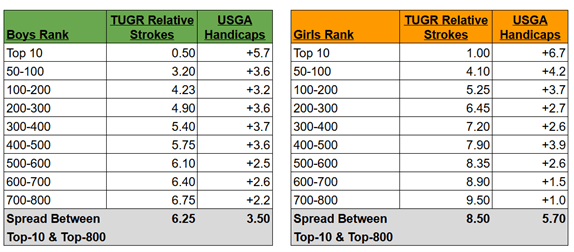
As you can see, the difference in a USGA handicap between someone ranked 800th and someone ranked 100th is very small, perhaps 1.5 shots per round looking at the Boys. However, using Relative Strokes as an indicator, there’s a difference of over 3.5 shots per round.
Internally, we’ve coined the phrase, “not all +3 handicaps are created equally.” USGA handicaps take in both practice and competition rounds while simultaneously throwing out the worse scores.
TUGR Relative Strokes uses all competition rounds. By comparing players to their competitors (not a course rating or slope), you cut through the noise inherently created in the GHIN formula, or other rankings systems, that use similar methods.
Concluding Thoughts
USGA Handicaps are very useful and we give them credit for finding a way to create a broad skill ranking for all golfers, however, in the landscape of competitive junior golf where the bulk of top-1,000 players have similar handicaps making it hard to compare players using this metric, a better system is needed for a baseline ranking.
Our goal is to help fuel better decision, lower scores, and epic days on the golf course.
Rankings are updated at http://tugr.org
Thanks,
Jeff

