- The Universal Golf Rankings
- Posts
- Comparing USGA Handicaps to TUGR Relative Strokes
Comparing USGA Handicaps to TUGR Relative Strokes
Why TUGR Junior 'Relative Strokes' can help cut through the noise of USGA Handicaps and give you a better understanding of a player's skill in competition.

TUGR Golf
January 22, 2025
As you can see, we have a new look for our weekly newsletter! With the accelerated growth of our company and user base, we needed a better platform to manage our weekly newsletters. We’ll test this out for a few weeks and see how it works. Thanks for all your support!
Case Study: USGA Handicaps & TUGR Relative Strokes
Quick Overview of Relative Strokes
One of the core pillars of TUGR Junior is to make sure everything we create and communicate is understandable. Transparency and understandability is of most importance. This filters right down to the numbers we post in the rankings, which is not a made-up number from a secret formula - it means something and can be helpful in your progression.
As most of you already know, “Relative Strokes” is the output of the TUGR Junior ranking system. The number next to any player in the rankings is their “Relative Strokes”. The #1 Player in the rankings (or in a specific ranking category; i.e., state, county, or class rank) is always the benchmark and that player will have a Relative Strokes of 0.00. Everyone else has a specific number that represents the expected shots per round they will shoot higher than the #1 player if they were to play in the same event.
We won’t dive deep into the details of the methodology today, but we calculate this using a head-to-head approach and utilizing the most advanced technology available to compare the tens-of-thousands of juniors in the database.
Comparing USGA Handicaps to TUGR Relative Strokes
Last summer we performed a study comparing the USGA handicaps of junior players to their TUGR Junior Relative Strokes to see if we could pick up any useful trends. Here is what we found:
USGA Handicaps can be somewhat misleading of a player’s true skill, consistency, and understanding if practice transfers to competition. Let’s look at this comparison table:
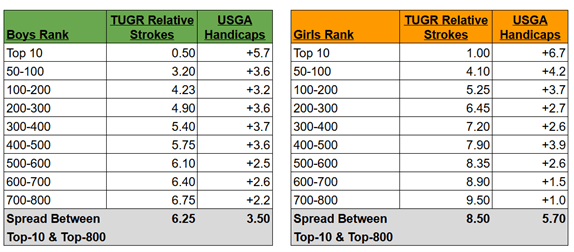
As you can see, the difference in a USGA handicap between someone ranked 800th and someone ranked 100th is very small, perhaps 1.5 shots per round looking at the Boys. However, using Relative Strokes as an indicator, there’s a difference of over 3.5 shots per round.
Internally, we’ve coined the phrase, “not all +3 handicaps are created equally.” USGA handicaps take in both practice and competition rounds while simultaneously throwing out the worse scores. TUGR Relative Strokes only takes in competition rounds, and by comparing players to their competitors (using head-to-head, not a course rating or slope), you weed out the noise inherently created in the GHIN formula.
Concluding Thoughts
USGA Handicaps are very useful and we give them credit for finding a way to create a broad skill ranking for all golfers, however, in the landscape of competitive junior golf where the bulk of top-1,000 players have similar handicaps making it hard to compare players using this metric, a better system is needed for a baseline ranking.
On the Overview tab of every player, you can find their ranking across 6 different categories along with their Relative Strokes to the #1 player in that category. Set a goal to close that gap on the city level; then move up to the county level and then the state. All of the tools are built to help you know exactly where you stand relative to your competition, while at the same time giving you the information to know where to focus your energy to improve.
Our goal is to help fuel better decision, lower scores, and epic days on the golf course.
Rankings are updated at http://tugr.org
We believe nearly all of the requests to add events have been completed, but as always, reach out if you see an event missing and we’ll get it loaded.
Thanks,
Jeff

