- The Universal Golf Rankings
- Posts
- Can we Quantify the Value of Course Length from a Rankings Perspective?
Can we Quantify the Value of Course Length from a Rankings Perspective?
Yes! How course length and scoring average can shed light on rankings

TUGR Golf
February 19, 2025
Is it possible to quantify the value course length from a rankings perspective? YES! Let’s dive in:
Analyzing raw scoring average and comparing it to a player’s average course length played can give us interesting insights into where juniors are ranked.
For juniors who want to play at the next level, navigating when to “move back” and play longer courses can be a delicate and tricky decision.
At TUGR, we’ve analyzed the correlation between raw scoring average, and average course length played, to give you an idea of where juniors are ranked based on these two metrics.
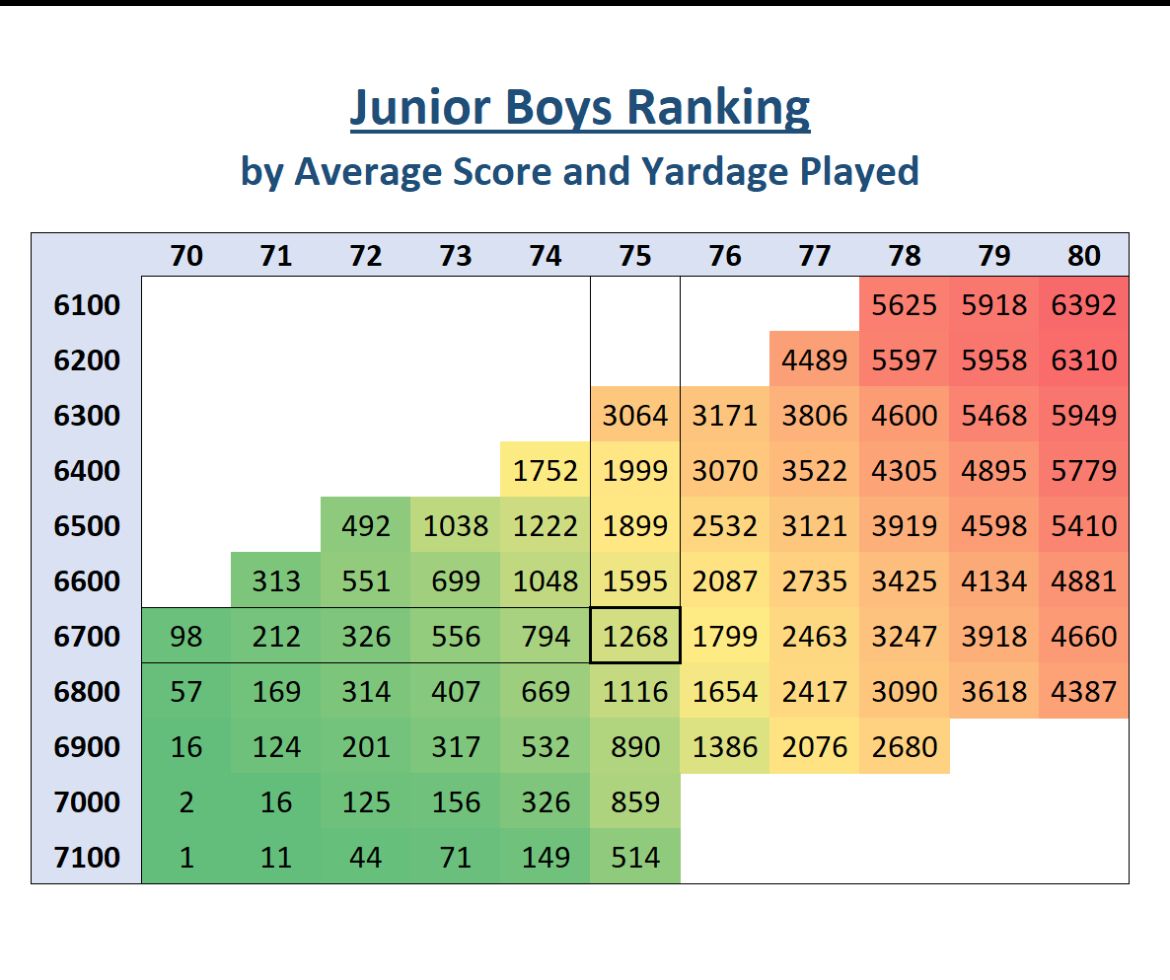
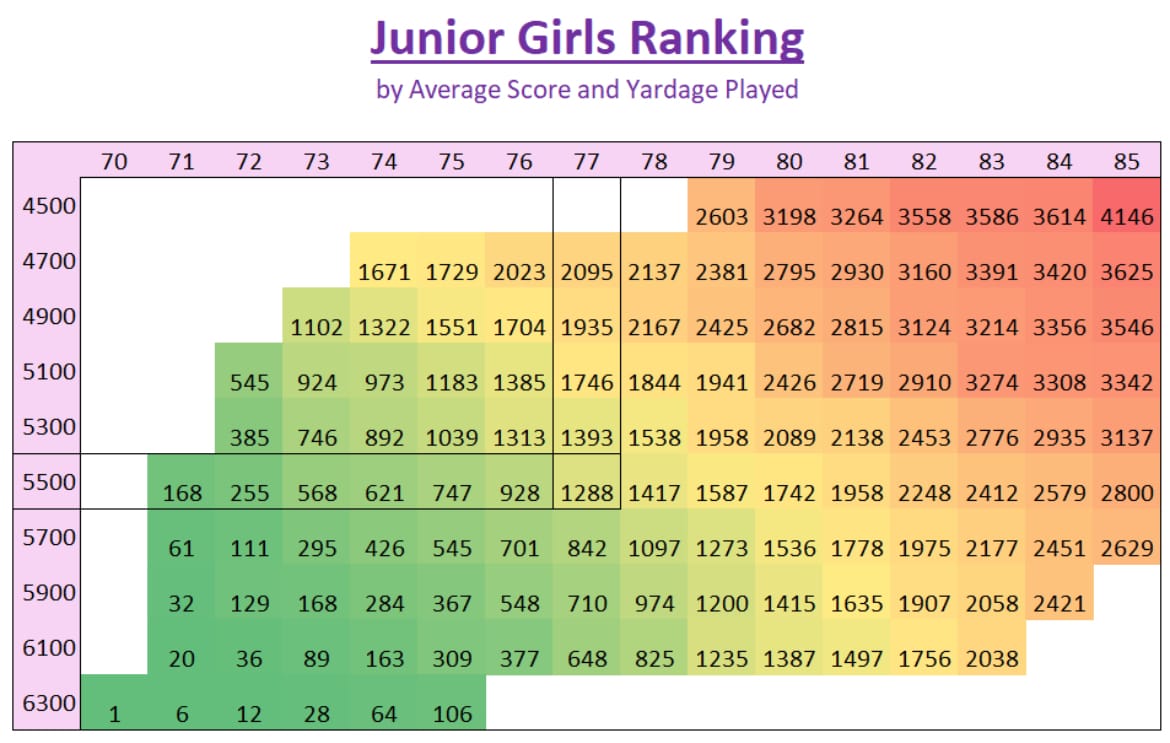
Take a look at the tables below. The x-axis is scoring average. The y-axis is average course length played. The number in the table represents the ranking of player at the intersection.
______________________________________________________
From paper lists to Amazon Prime, times have changed.
While fast shipping and exclusive shows are well-known, these 10 hidden perks can take your membership to the next level.
_______________________________________________________
Interesting data, isn’t it! What can we learn from this?:
For Junior Boys, look at the ‘73’ column. You can see the average rank of a junior boy who shoots 73 and plays courses at 6500 yards is ~1,038th. What if a player who fit this profile were to move back tees and start playing courses at 6700 yards? Well, if that caused him to lose about 1 shot on average, then he would actually increase his rank. You can see the average rank of a boy who shoots 74 at 6700 yards is ~794th.
For Junior Girls, look at the ‘77’ column. You can see the average rank of a junior girl who shoots 77 and plays courses at 5100 yards is ~1,746th. What if a player who fit this profile were to move back tees and start playing courses at 5300 yards? Well, if that caused her to lose 2 shots on average, then she would fall in the rankings. You can see the average rank of a girls who shoots 79 at 5300 yards is 1,958th.
Here’s the punchline:
All things being equal, how a player scores relative to the length of the course has a direct correlation to their ranking.
Obviously, there are hundreds of variables that affect scoring, that’s the whole point of the TUGR methodology to accurately capture and rank players in an unbiased way; however, isolating course lengths can give useful insights.
If you analyze the table, you can see the numbers shakeout to this general rule of thumb for both boys and girls:
Think of strokes and yards as an exchange rate on your ranking. On average, in the junior ecosystem, the exchange rate needed to not affect a player’s ranking, is the following:
200 yards = 1 stroke
If you can “beat” the exchange rate, your ranking will probably go up as you move back, all things being equal.
Remember! Progress is never a linear experience. We can’t hammer that notion enough. Look at progress in 6-month chunks, not 6-week stretches. Every junior experiences volatility in scoring as they play longer courses.
Don’t overanalyze the ups and downs of scoring average. It may be as simple as course lengths being played. Don’t get too caught up in that game, but we thought you would appreciate seeing how the numbers shake out and how you really can ‘value’ yards in the currency of strokes to a pretty accurate degree when looking at rankings.
Rankings are updated: http://tugr.org
Our mission is to fuel better decisions, lower scores, and epic days on the golf course. Reach out with any questions.
Thanks,
Jeff

